

Caerlaverock Community Association has just installed two defibrillator units for public use in the area.
They have been placed in the red phone boxes at Glencaple Quay End, and at Bankend.
We have decided after some consultation to provide them without a locking pin number attached – several crucial minutes could be lost. (Both units have been etched with the locations, so would be awkward to sell on if anybody was foolish enough to try and steal them! Also important to note that they will not give a shock if a heartbeat is detected so you can never hurt someone unintentionally).

Jordan installing one of the defib units in Glencaple, and the other all set up in Bankend.
As you only have a few minutes to get a non responsive casualties’ heart going again, anyone using a defibrillator promptly (within 1 to 2 minutes) will give the casualty the best chance of survival – it is one of the few things a lay person can do to save someone’s life.
Follow the instructions – they are intentionally user friendly.
Watch the videos below, read the information and follow the links at the bottom – they will give you an idea of what to do in this emergency situation in the meantime.
We will be organising another training session for anyone interested to come along to be trained and to experience using a defibrillator, so please keep an eye on this website and our Facebook page for an upcoming date.
Training Session
Iain Howie came along to demonstrate to CCA members how to use the defibrillators.
Iain was a policeman for 30 years and was trained in his current role by the Scottish Ambulance Service. He gives British Heart Foundation “Heartstart” training. Our defibrillators are the Philips FR2. (click here for full manual)
Here are three video clips from the training: thanks to the participants of the videos for being good sports!
DRs (doctors) ABC: Check area for Danger, check casualty for Response, Shout for Help, open Airway, check for Breathing.
If not breathing normally Call 999 – phone for an ambulance
DRs (doctors) ABC: Check area for Danger, check casualty for Response, Shout for Help, open Airway, check for Breathing.
If not breathing normally Call 999 – phone for an ambulance
DRs (doctors) ABC: Check area for Danger, check casualty for Response, Shout for Help, open Airway, check for Breathing.
If not breathing normally Call 999 – phone for an ambulance
Here is an overview and some notes of the training we received from Iain, which will be of great use to anyone who has received training to help refresh their memory! Although any member of the public can use a defibrillator, it is recommended that anybody interested in being able to operate these units receives full training.
If there is anyone defibrillator trained (medical professionals, current First Aiders), please do get in touch with us on caerlaverockcommunity@gmail.com
>> CLICK FOR A PDF OF THE TRAINING DOCUMENT
>> BRITISH HEART FOUNDATION ADVERT – Realistic video – symptoms of heart attack.
>> HELICOPTER HEROES – BBC CLIP of CHRIS SOLOMON’S HEART ATTACK – Video recorded during filming the series – actual footage of heart attack and cardiac arrest.

1. Early recognition and call for help – 2. Early (CPR) Cardiopulmonary Resuscitation
3. Early defibrillation – 4. Post-resuscitation care in hospital.
Many thanks to Alison Robertson (already trained in using a defibrillator) for taking and writing these brilliant notes:
Heart attack vs cardiac arrest (heart stops beating)
It’s important to know what a Defibrillator does, and when it is used. It is not used on somebody who is having a heart attack – but *IS* used if that person goes into cardiac arrest. That is, when their heart stops beating and goes into ventricular fibrillation. Time is of the essence here, as they will only have a few minutes to live unless their heart can be made to beat normally again.
60% of heart attack casualties end up arresting so you should have a defib ready if treating a suspected heart attack. (Scottish Ambulance Service advise against putting defib pads on a conscious heart attack casualty as it will increase their anxiety, but certainly do have the defib unit handy.)
Recognising a heart attack
No two heart attacks are the same. Women often, though not always, do not have the classic central chest pain. People may just feel very tired. There is a variety of symptoms (crushing central chest pain radiating down arm and up to jaw and/or difficulty breathing and/or pins and needles and/or feeling of indigestion …) so any symptoms above the waist that do not go away, think heart attack. Give an aspirin to suck – (When taken during a heart attack, aspirin slows clotting and decreases the size of any forming blood clots) – and Call 999.
>> CLICK HERE TO FIND OUT MORE ON HEART ATTACK SYMPTOMS
CPR – cardiopulmonary resuscitation
There are 700,000 cardiac arrests a year in Europe. If CPR is not performed, someone suffering a cardiac arrest will die in 4 minutes. 10-12 minutes’ CPR can keep someone alive. Try to defibrillate them within 2 minutes. A defibrillator only works if the heart is in ventricular fibrillation (electrical activity of ventricles goes haywire, resulting in the heart quivering instead of beating regularly). This is what the defib is looking for as it analyses the heart’s rhythm.
In the UK, 5-10% of cardiac arrest patients end up being discharged from hospital. This includes those who arrest while in hospital, so the figure for those suffering a cardiac arrest outwith a hospital is lower than 5%. In Scandinavia it’s 30-40% as defibrillators are everywhere and everyone knows how to use one. CPR including defibrillation is taught in schools… so this is our chance to make a difference to those stats and save lives by knowing how to use these machines.
>> CLICK HERE TO FIND OUT MORE ABOUT CPR
Treating a casualty
If you suspect someone is having a heart attack or has gone into Cardiac arrest:
- Approach safely (look for DANGER)
- RESPONSE? If unresponsive, SHOUT “HELP!”
- Open AIRWAY (hand on forehead, fingers under chin, tilt head back)
- Look, listen and feel for normal BREATHING for up to 10 seconds. Beware of agonal breathing: it’s not normal; it is noisy and gasping and is a symptom of cardiac arrest.
- Someone unresponsive and not breathing normally is in cardiac arrest so CALL 999 for an ambulance, stating non-responsive, non-breathing casualty. Ask someone to fetch a defibrillator.
- If you have the defibrillator with you, attach it to the casualty (see below) and follow instructions. If not, begin chest compressions. If you have another trained person present, swap every 2 minutes as compressions become less effective as you get tired. Do them at a rate of 100-120 per minute, to the rhythm of “Nellie the Elephant” or “Staying Alive”.
- For adults, Iain advises giving chest compressions ONLY, not the customary sequence of 30 compressions followed by 2 ventilations. After 5 minutes, oxygen saturation of blood is still 70% and chest compressions will get this remaining oxygen pumped around the body quickly. Breaking off from chest compressions to perform two ventilations means a 13 second interruption in the chest compressions.Casualties often vomit during CPR so that’s another reason you don’t want to be giving ventilations. Note that vomiting is usually associated with people having a heart attack, rather than during a cardiac arrest. This for most adult casualties: ventilations (at ratio 30:2) should be given a) to children (main cause of paediatric cardiac arrest is eg respiratory problem, not heart problem); b) to an adult whose cardiac arrest was caused by asphyxiation (eg drowning); and c) where ambulance is going to be delayed (eg rural area).
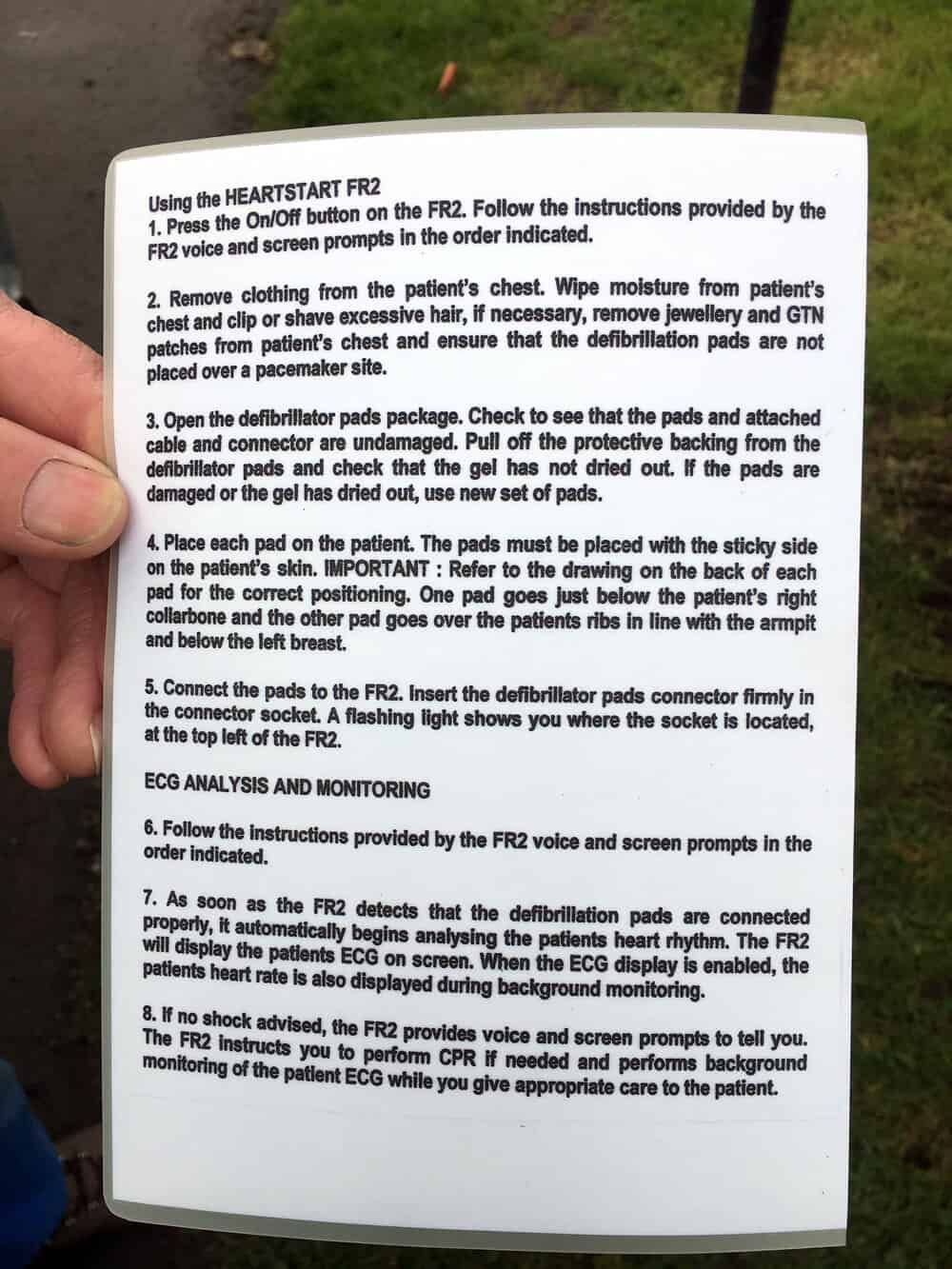 Some important notes on using the defibrillator
There are printed instruction sheets in each phone box showing you how to use the FR2 unit. Please familiarise yourself with these instructions.
Here are some more tips from Iain:
- Remove (cut if quicker) all clothing from top half of body including underwear, preserving decency as much as possible. Remove nicotine patches if possible. Anything metal will cause burns but leave piercings in place. If there are two of you, CPR can continue while this is being done.
- Shave chest if very hairy. Usually applies only to men. Towel dry if wet.
- Do not use a defibrillator in water. Preferably carefully remove casualty even from a puddle. Attach pads to casualty, ideally one below right collar bone and the other over left ribs – but doesn’t matter if it’s the other way round.
- Plug lead into machine and switch on. Follow the spoken instructions.
- Stop CPR while it analyses the heart’s rhythm.
- Do not let anyone touch the casualty while the machine is analysing the casualty’s heart or administering a shock. The machine is very sensitive and will detect both pulses.
- If a shock is not advised, continue CPR.
- If a shock is advised, press the orange button. After giving the shock the machine will typically remain silent for 2 minutes
- Once a shock has been given, resume CPR.
- After the two minutes, it will again prompt you to stand clear while it analyses the heart rhythm.
- It usually takes 2-5 shocks before the casualty responds.
Infant and Child Resuscitation (unless trained otherwise, perform adult sequence of resuscitation)
- Child aged > 8 years: treat as for adult.
- Child aged 1-8: use paediatric pads (these reduce the output of the machine. Use adult pads if paediatric pads not available). Compressions 1 or 2 handed depending on size of child, to a third of the chest depth.
- Child <1 yr old: use paediatric pads (adult ones if not available). Chest compressions using two fingers, to a third of the chest depth.
Defibrillator symbols – checking if charged and ready:
- Flashing egg-timer: working and OK to use.
- Flashing red cross: 4-6 weeks of battery left so get a new one.
- Solid red cross: battery is dead. It also chirps if the battery is dead.
Other conditions mentioned by Iain
TIAs (Transient Ischaemic Attacks) = mini stroke.
Symptoms disappear within 10 minutes.
Do all the stroke tests (ask to raise both arms, smile, speak).
Call 999 for ambulance as the casualty may have a major stroke within 24 hours.
Tell ambulance operator that a stroke is suspected, not simply that the person had a dizzy spell or any other trivial-sounding symptom.
Huge advances in stroke treatment in recent years mean that nearly all symptoms can be relieved, but only if the casualty is in hospital within an hour.
To cover the cost of purchasing and essential maintenance of these units, they were funded by donations left by motorhomers and other visitors to the Quay End at Glencaple over the year, so thank you to all who kindly helped support the provision of these units!